
The re.photos app is here!
Realized with the generous support of the Sievert Stiftung

Thanks! I don't measure the focal length precisely - I mainly try to stand in the same spot and then zoom until the perspective matches by eye.
Thanks! I don't measure the focal length precisely - I mainly try to stand in the same spot and then zoom until the perspective matches by eye.
That's a good question! Honestly I don't really track focal lenghts, I usually match by eye. For panoramic views from far, like this one, I usually don't have any problems, it's only tricky sometimes with close buildings. It's cool that you're researching that! I should maybe get more into that as well. For this photo I used a Sony DSC-RX100M2 with the focal lenth at the wide end (10mm).
That's a good question! Honestly I don't really track focal lenghts, I usually match by eye. For panoramic views from far, like this one, I usually don't have any problems, it's only tricky sometimes with close buildings. It's cool that you're researching that! I should maybe get more into that as well. For this photo I used a Sony DSC-RX100M2 with the focal lenth at the wide end (10mm).
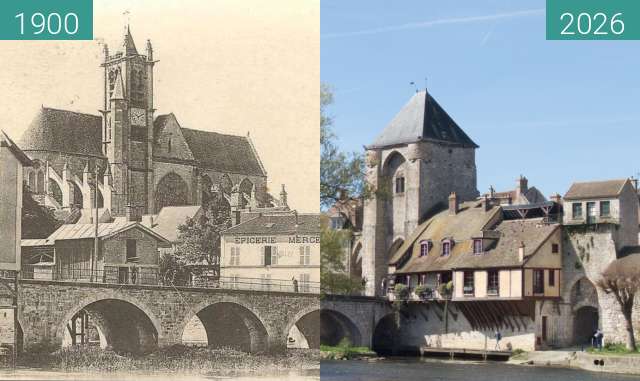
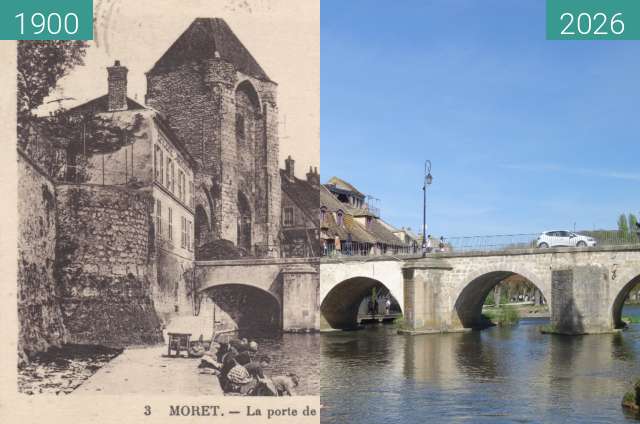
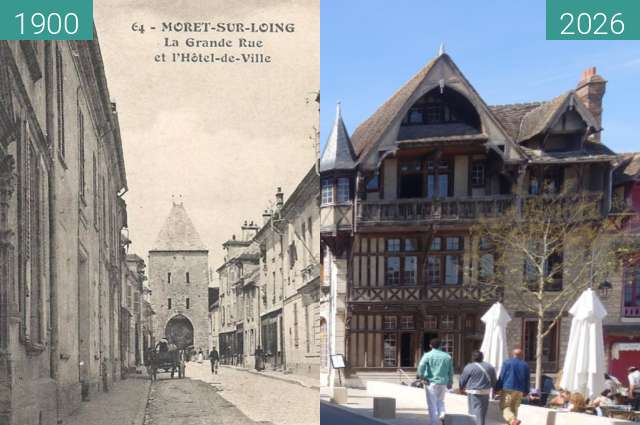
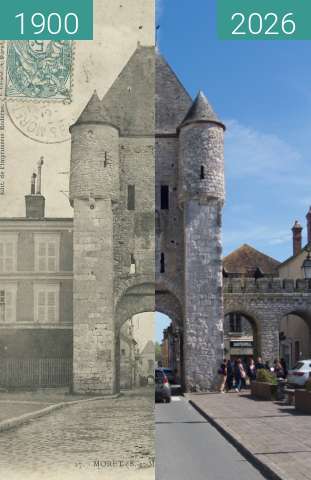
Moret-sur-Loing is an ancient town on the banks of the Loing River near the mouth of the Seine, in the Seine-et-Marne department. Due to its location, it played an important commercial and military role in the Middle Ages. Many of its town fortifications, built primarily under Philip Augustus around 1200, are still preserved today, including the two city gates, the Porte de Bourgogne (seen here on the right in the picture) and the Porte de Samois. The Église Notre-Dame de Moret also dates from the same period.
Originally, there were numerous mills along the bridge. These disappeared in the course of industrialization and due to destruction during World War II, when the retreating German army blew up the bridge. The mill visible in the picture is a later reconstruction in the historical style.